GULPS
GULPS is a two-qubit gate synthesis package for arbitrary native instruction sets. Given a set of native two-qubit gates and a cost for each, it selects the least-cost sentence, an ordered list of native gates with single-qubit gates before, between, and after them, that implements a target unitary. It then constructs those single-qubit gates with a dedicated solver, can_sandwich.
Synthesize into your instruction set
Install GULPS with the plotting dependencies that the examples in this guide use:
pip install "gulps[viz]"
The native gates can be any two-qubit gates
with fixed parameters: Qiskit standard gates with bound parameters, or your
own matrices wrapped in UnitaryGate.
from qiskit.circuit.library import CSXGate, iSwapGate
from qiskit.quantum_info import random_unitary
from gulps.decomposition import GulpsDecomposer

target = random_unitary(4, seed=0)
decomposer = GulpsDecomposer(
    [CSXGate(), iSwapGate().power(1 / 3)], costs=[90, 120]
)
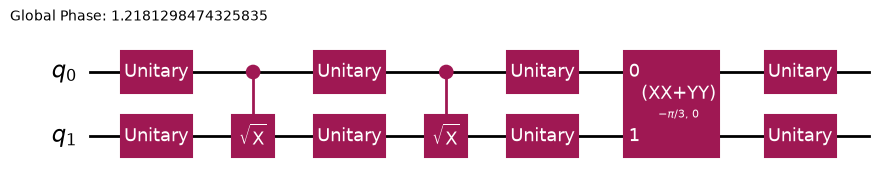
circuit = decomposer(target)
circuit.draw("mpl")
from qiskit.quantum_info import Operator, process_fidelity

print(f"Process fidelity: {process_fidelity(Operator(circuit), target):.12f}")
Process fidelity: 1.000000000000
A cost can be a gate duration or any other quantity that adds up along a sentence. In this example, single-qubit gates cost nothing. Compilation adds a charge for each layer of single-qubit gates, runs GULPS in a Qiskit pass manager, and queries synthesis costs from other transpiler passes. Pulse duration calibration uses synthesis costs to choose which native gate durations to calibrate.